Filter by topic and date
A new suite of modern tools coming for editing and publishing RFCs
6 May 2026
After a number of years of work, the initial rollout of a modern suite of tools for editing and publishing RFCs, including an entirely new rfc-editor.org website, will take place during the week beginning 11 May 2026.
Since its inception in 1969 with the publication of RFC 1, the RFC Series has had a formal editing and management function that has evolved through multiple iterations, as the series has itself evolved, to the RFC Editor function that we have today. Now with over 9000 documents in the series, RFCs are authored in a variety of tools, often tracked through formal version control, published in RFCXML, and rendered into multiple presentation formats. The role of the RFC Production Center (RPC), the team that delivers the RFC Editor function, has changed significantly as a result.
In recent years it became clear that the tools used by the RPC could not adapt as needed to support these changes. The underlying database was too old, too rigid and too fragile, the editing tools were a large collection of unrelated and hard to maintain scripts, and the rfc-editor.org website was built on a platform far too old to add new functionality and improve usability. In particular, it was clear that the current tools could not support the editing or publication of RFC 10,000 and beyond.
In mid-2022 the IETF Administration LLC began a project to completely rewrite all of the RPC tools and add the new functionality that authors and the community had long been asking for, comprising the following:
- The RPC database and workflow system will be migrated into a new application tightly integrated with Datatracker and using the existing Datatracker database of RFCs. The work on this has included:
- Many hours of manually reconciling differences in data between the RPC and Datatracker databases to provide a single source of truth.
- Implementing a new flexible state management system to allow for RPC processes to quickly adapt to meet future needs. This was in direct response to the many editorial process changes that have either been hard to implement or taken years longer than expected. This also provides for full end-to-end measurement of the RFC editing process, which has not been possible before now, and higher granularity measurement of individual parts of the process.
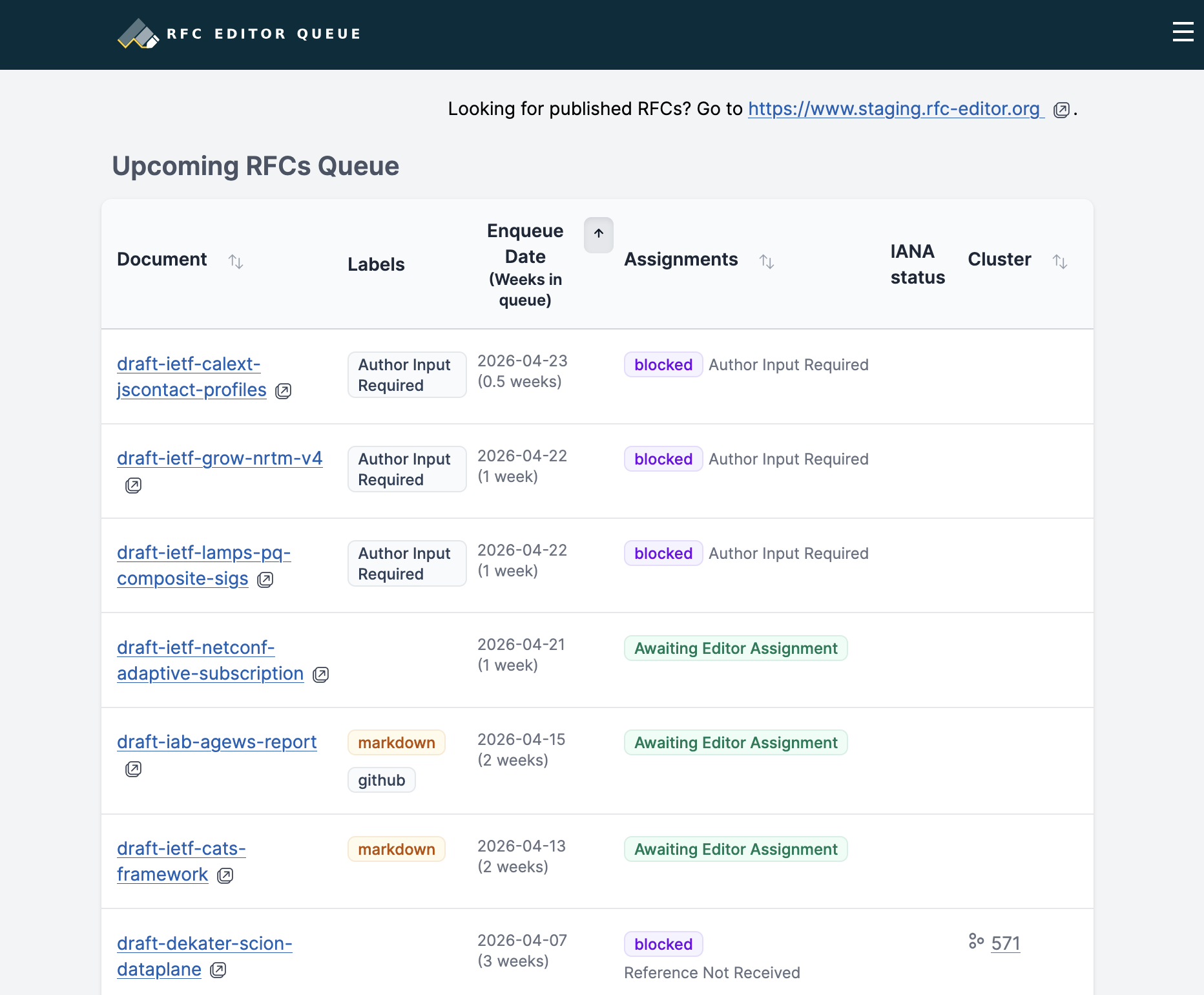
- An authors’ (public) view of the editing status of every document in the publication queue through the new subsite queue.rfc-editor.org.
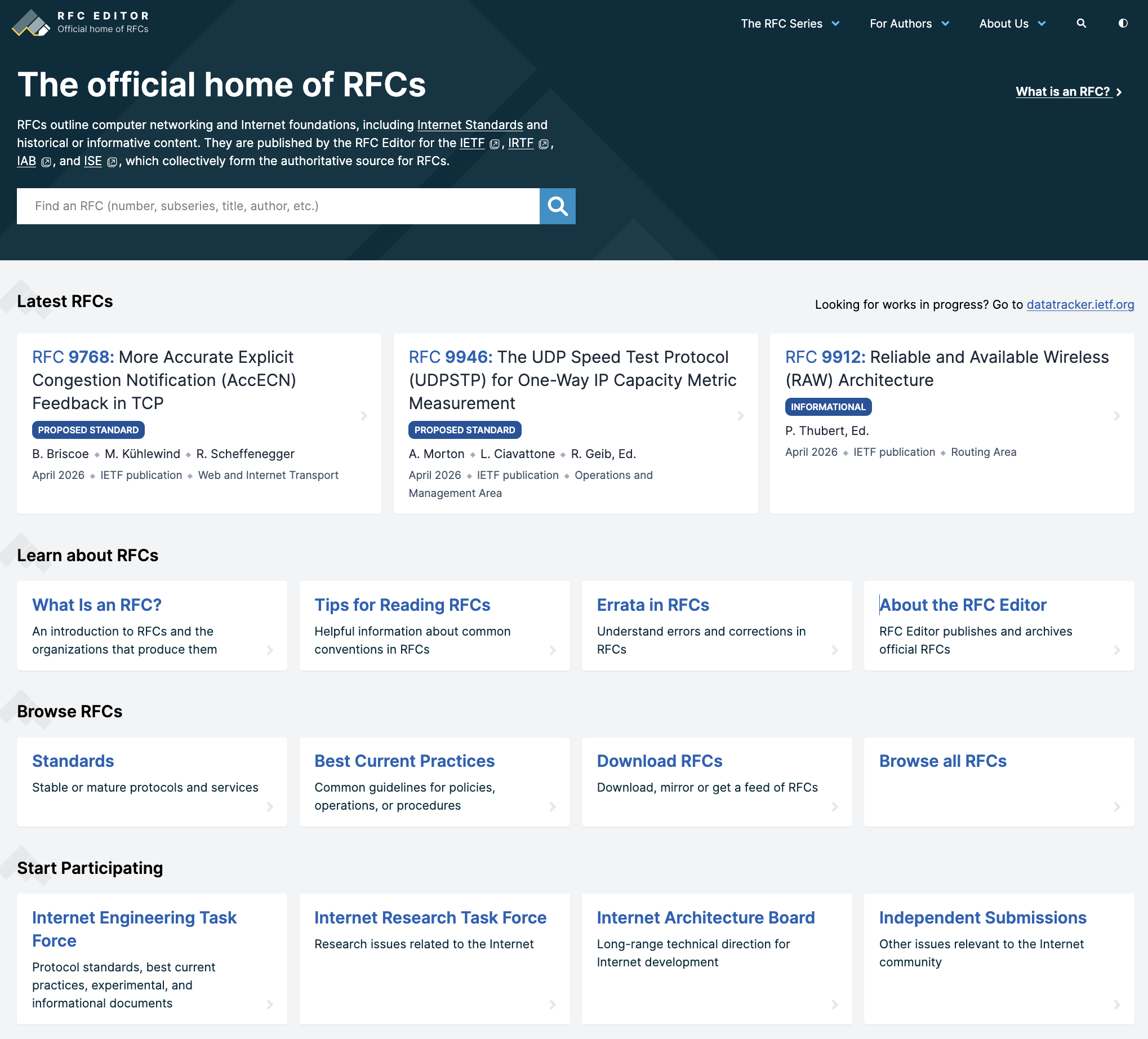
- The RFC Editor website will migrate to an entirely new site that is designed around the needs of RFC consumers and sets the scene for more advanced features to be added. The work on this has included:
- Using professional UX designers and accessibility specialists to completely redesign and test the website experience, and then implementing that in a modern web framework. The site will be a high-quality, authoritative and accessible site for RFCs.
- Connecting to the new database and front-end object stores through all new APIs to support five-digit RFCs and beyond, faster page delivery under heavy load, and more efficient bulk access.
- Implementing a new errata system at errata.rfc-editor.org. This is substantively the same as the existing system with improved screening of reports and new login integration with Datatracker.
- Implementing a new search system with both full text and enhanced metadata searching.
- The RPC will migrate to a new editing tool, DraftForge, a Visual Studio Code plugin that provides a one-stop user interface for all their editing tools. The work on this has included:
- Rewriting the tens of individual scripts (some of which are in Tcl and 40+ years old) and adapting them to use a common user interface.
- Connecting existing plugins that provide necessary functionality (e.g. RelaxNG validation) and adding new functionality to access the new RPC database.
- Creating a plugin with two modes, one tuned for the RPC and one that authors might elect to use when writing RFCs.
This comprehensive overhaul has built on the work and close collaboration of the IETF Tools team and the RPC. The RPC has dedicated significant resources to specifying their requirements, reviewing plans, testing releases, migrating data and work in progress, and training staff to use the new tools.
Progress on the updated www.rfc-editor.org website has been previously shared over the past year during community calls and with a hands-on demo during the IETF 124 Montreal meeting.
In the week beginning May 11, 2026, the initial rollout of these new tools will take place, with rfc-editor.org updated on May 13. With any rollout of this scale and degree of change we are expecting some complications and staff will be ready to address any serious issues quickly in order to minimise the impact on the IETF Community and RFC Consumers. There will be subsequent phases to this rollout in the months following and the last phase of the rollout is expected to be in December 2026.
In addition to the benefits above, this rollout provides the platform for two further improvements to the RFC Editor function. The first is that it allows us to collect the data needed for a better RPC SLA, and consultation on what that should be will start soon. The second is for an extensive set of new features for the rfc-editor.org website intended to support implementers, researchers, and others using RFCs. Work on this is well underway with the design phase completed and implementation in progress.
The update is not expected to result in any downtime for the www.rfc-editor.org website; there may be a one-day pause of submitting and processing errata. Should the schedule change, further details will be provided closer to 13 May.